Showing posts with label Teachers. Show all posts

Monday, December 7, 2015

Novel Projects - Characterization


4LB has just finished a round of novel studies/lit circles, and one of the projects I wanted them to do was to demonstrate their understanding of a character from their novel.  I asked the students to take an event from the story, and then try to put themselves in the character's shoes and imagine the scene from his/her point of view.  (CCSS.ELA-LITERACY.RL.4.3 Describe in depth a character, setting, or event in a story or drama, drawing on specific details in the text (e.g., a character's thoughts, words, or actions) in Common Core speak!)

Step one, obviously, is to have students select a character, and then choose a scene that the character had a large part in.  Have students reread the scene so it's fresh on their minds, and then retell the story as if they were the character.  A good scaffolding activity for this is to have students do a character analysis graphic organizer first...something like this:  Character analysis graphic organizer .  This is a little one I made--you can also find a jillion different versions online or customize to suit your own needs.  I just whipped this one up in Powerpoint and saved in my google drive, or you can do it straight in Google Presentations.  Or use mine!

Next, we wrote out scripts for our retelling of the event from the character's point of view.  Students did these in their reading journals.  Then we drew pictures of what we thought the characters might look like based on descriptions we had found in the novels.  Our novels were Frindle, Tiger Rising, and Tuck Everlasting.


Here is a script for Nick from Frindle
A student drawing of Mrs. Granger from Frindle


Next, we used the Ipads to take a photo of our drawings and then uploaded them to the Morpho Booth app.  You can also use the web program called "Blabberize", but Morpho Booth lets your characters look more 3D and I find the sound quality is better.  You can see a finished product here:


Nick from Frindle - by Joseph


Rob from Tiger Rising - by Maria (she used a feature on Morfo booth to change her voice)


Wednesday, October 21, 2015

Writing Focus - Feature Articles


Our second writing unit is a more interesting form of informational writing--we are writing feature articles.  This idea came out of some of our teacher sessions with the educational consultant Matt Glover, on teaching writing through inquiry.

We began the unit with an immersion into reading a variety of feature articles,  noticing things they all had in common that made them stand out.  We discovered that this worked best if we read the articles twice--the first time as a reader, just to see what the article was about.  Then we read the article again as a writer, noticing things the author did to catch our attention.

Our feature articles came from a variety of children's magazines, such as Ranger Rick, National Geographic for Kids, Scholastic.  Feature articles become the mentor texts for this unit, and we refer back to them many times throughout the unit.

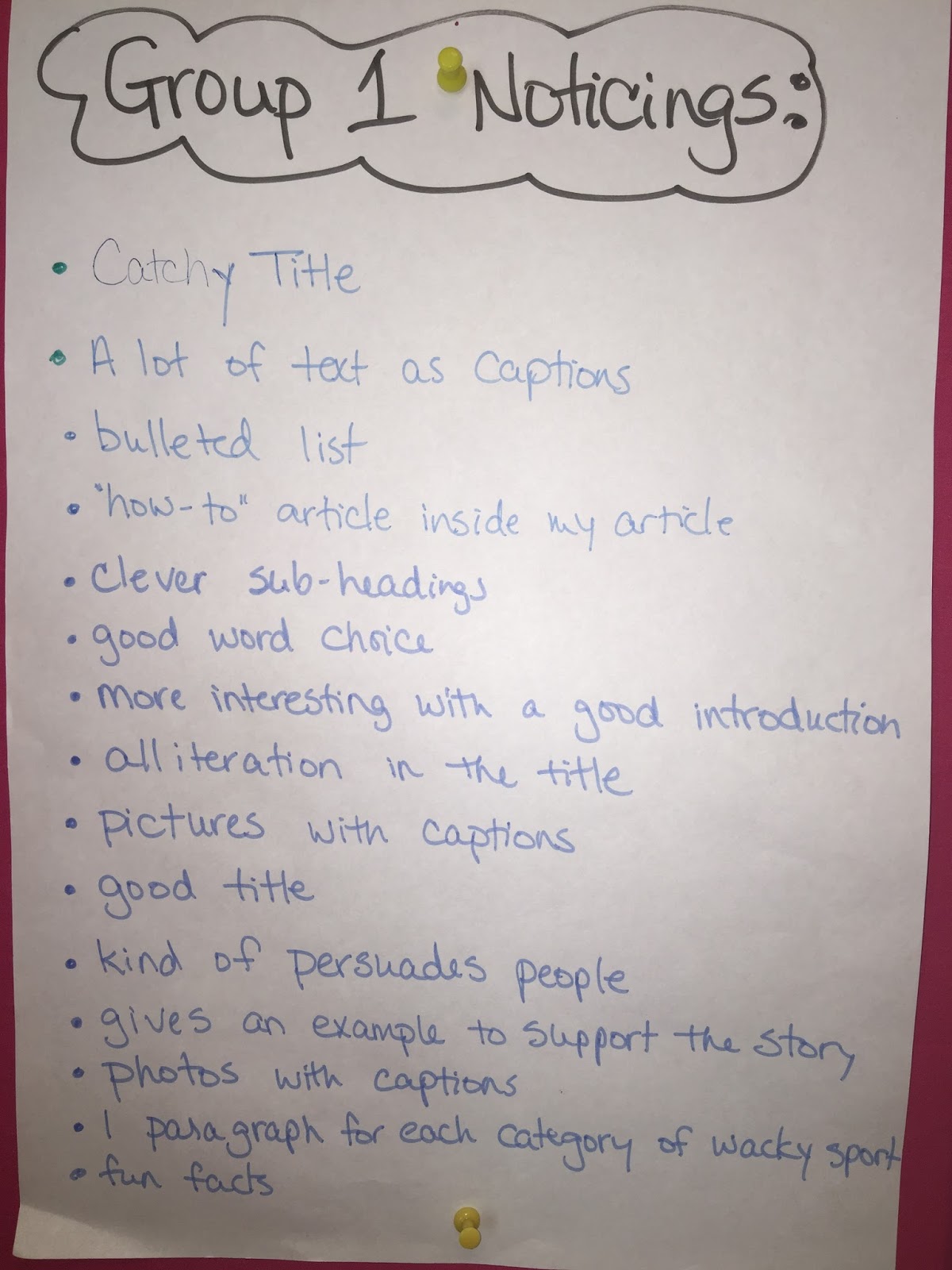
I worked with each table group of six students.  First we read one article all together, talking about some of the things we noticed.  Then each student read an article and reported back to the table some of the things they "noticed" in their article.  We made a list of all the "noticings", especially when the "noticing" appeared in several of the articles.  While I worked with a group, the other tables were doing some of their reading rotations--one group worked on IDR (Independent Daily Reading) and another group worked on the comprehension activity of the week--finding the main idea.
Some of the things we noticed.  
*********************************************************************************

In the next mini-lesson, we took a closer look at how the author organized the information.   First we gathered on the carpet as I modeled reading the article and noticing how the information was organized.  (Our lessons on main idea and supporting details really came in handy here!)   Then students went back to their table groups and I gave each table one of the mentor articles to "look closer" at.  Students presented their findings to the class.


My clever students figured out that since they were already doing so much research about biomes for their Unit of Inquiry projects, that it would be a natural fit to have their feature article tie in to that presentation.  I just love it when our Units of Inquiry have a natural fit in several areas, and love it even more when the kids make the connections!


Sunday, October 18, 2015

Reflection and Goal Setting


A big focus in the elementary school this year is metacognition--getting students to think about their thinking and to reflect on their learning.  Research indicates that having students reflect on their learning allows students to make connections with previous knowledge and build on it, leading to a deeper level of understanding and synthesis of knowledge.  One way we do this is to set aside one class period per week to reflect on our learning.  We have a variety of things we do to reflect on our learning in 4LB--we may:


  • go through some of our math "exit tickets" and record in our math journals
  • reflect on a piece of writing we've done
  • set goals for what we want to accomplish during writing time
  • share our writing and notice what we did well
  • update our E-portfolio blogs (another way of reflecting on our learning)
  • evaluate ourselves based on rubrics
Reflecting on math

Sharing our writing and reflecting on what we did well

Looking over our work


Thursday, September 17, 2015

Personal Narrative Writing - Planning and Drafting


So we've got all those ideas flowing out of us, and now it's time to commit that one special story to paper.

First I had my students take a piece of A-4 paper (regular copy paper) and fold it in half into  a "hamburger" fold.  We repeated this twice more for a total of three folds.  (It's always fun to throw a little math at them and have them predict how many rectangles they will end up with and they are usually surprised when it is not six!)   So we end up with a piece of paper divided into 8 small rectangles.

Now the kids take their story idea and plot it into the squares.  I showed them my story, all plotted out, and how I figured out the beginning and ending box first, and sort of aimed to have the most exciting part of the action in about the 5th or 6th box.  You could also look at your story on a plot diagram and talk about the rising action, the climax of the story, etc..

Hee Young plotting out her story!

Stories all plotted out


I was most excited that even my beginner ESL students had success with this.  From the drawings and their text explaining the drawings, it was fairly easy for students to work these into a first draft on their personal narratives.

Sunday, September 6, 2015

Personal Narrative Writing - Setting the stage


So personal narratives, or a story from one's own life, should be one of the easiest types of writing to do, right?  But that blank white piece of paper staring at the average 4th grader is still a daunting canvas.  As a teacher, I have really changed the amount of time I spend on pre-writing.  First, I like to convince my students that they actually do have stories to tell!

I start off very innocuously,  mentioning some memories from my childhood of very typical childhood experiences. This may happen at odd times, like snack time or morning meeting starting several days before we are set to begin the unit.  I may mention the time I had to get stitches, the time I went camping, the time I had a wiggly tooth and my dad yanked it out with a pair of pliers!  And you know what?  Nearly every hand in the room is up wanting to tell their memories of those experiences.  Next, we played a little game with a deck of conversation cards--we sat in a circle and passed the cards.  Each student drew a card--like "Tell about a time you were surprised" and then told a quick story about their life experience.  Then my students decided they would like to do a couple of rounds in their table groups so they would get to "tell more stories".  Yeah!  Exactly what I was hoping for!  I used a deck of conversation cards that I happened to find in Iceland (fortunately the cards were in both Icelandic and English!).


With all those stories and memories swirling in our heads, it's now time to do some "heart mapping".  There are various lessons and ideas out there on this concept, but I really like Georgia Heard's Heart Mapping activity.


Students select their favorite narrative idea and then pair up to retell the story to a partner.  I find that telling the story first makes it much easier to write about.    And after all this idea generating, we will soon be ready for those blank white pages!  More coming soon...